I have previously written in this blog about Elizabeth Winkler’s slight of the case for Bacon in her book, Shakespeare Was a Woman and Other Heresies (“Why Did Elizabeth Winkler Not Interview Any Baconians?” https://christinagwaldman.com/2024/06/27/why-did-elizabeth-winkler-not-interview-any-baconians/). In a comment made one year ago to that post, Mark Rylance attempted to apologize for not coming out stronger as a proponent for Bacon’s contribution to Shakespeare authorship in Winkler’s book. He seemed to be including Winkler in his apology. I had hoped Winkler was sincere and would try to “bone up” on the case for Bacon.
However, I just watched her talk last December at the American University in Paris, “The Shakespeare Industry with Elizabeth Winkler,” Youtube, 12/6/24, https://www.youtube.com/watch?v=bUafv5ryHm8. After rhetorically asking who might be the real Shakespeare, she said (beginning at 17:39):
Was it Francis Bacon, the Elizabethan Philosopher and Statesman whose knowledge of law, philosophy, foreign languages seemed to match the knowledge in the works? In 1603 Bacon wrote a mysterious letter to a lawyer who was riding to meet the new King James I and he signed off with this wish, ‘So desiring you to be good to concealed poets ….’ So who was the concealed poet? Was it Christopher Marlowe, a playwright and government agent who disappeared in 1593 supported, uh, reportedly murdered just weeks before Shakespeare emerged? What about Edward de Vere, the eccentric 17th Century Earl of Oxford, probably the favorite candidate today …?
(Actually, Bacon’s career spanned both Queen Elizabeth and King James’s reigns.)
One must wonder whether Winkler had actually read the letter she quoted. For, if she had, she would have seen that Bacon was clearly referring to himself as the concealed poet. There was nothing “mysterious” about the letter, though his reference to himself was cryptic. In it, Bacon asking his friend, a fellow poet, to put in a good word for him with King James, as Bacon was desirous to gain a position in the new government. Winkler bypasses the obvious meaning and asks ridiculous questions: Could Bacon have been referring to Marlowe? Or the Earl of Oxford? Or a woman writer? Of course not. She pretty much answers her own question as to Marlowe, for he had disappeared in 1593. The Earl of Oxford died June 24, 1604, the year after the letter was written. Why would Bacon have asked John Davies to be good to either of those men? It would seem that, had she read the letter, she would not have had to ask.
The Youtube video has been seen by 5.5K viewers, according to the Youtube site. In it, Winkler claims to be taking no side in the debate. She has been given a public podium; people will trust what she says. She holds a masters degree in English literature from Stanford. People will assume she has done her research, that she is some sort of expert. However, there is always more to learn, even for an “expert.” Nowhere is that more true than in Shakespeare authorship studies. One would not want to mislead others.
There is an Oxfordian precedent for using the term “concealed poet” to refer to the Earl of Oxford: Roger Strittmatter does so in his Ph.D. dissertation, “The Marginalia of Edward de Vere’s Geneva Bible: Providential Discovery, Literary Reasoning, and Historical Consequence” (University of Massachusetts, February 2001). He cites passages by J.T. Looney in his 1920 Oxfordian book, Shakespeare Identified, and by Andrew Lang. In his dissertation, Strittmatter primarily argues that the marginal notes in de Vere’s personal copy of the Geneva Bible are evidence that he wrote the Shakespeare plays and poems.
While Strittmatter gives Bacon the credit for saying “concealed poet” in two footnotes, his second footnote is inaccurate: the date of the letter is 1603, not 1602. More importantly, it was a letter from–not to–Francis Bacon, and to–not from– Sir John Davies (“438 The phrase is from a 1602 letter (Lambeth Palace MSS. 976, fo. 4) to Francis Bacon from Sir John Davies which ends with the salutation [sic] ‘desiring you to be good to concealed poets’ (Hope 1993).” His cited source is not Spedding but a secondary source, Warren Hope and Kim Holston, The Shakespeare Controversy: An Analysis of the Claimants to Authorship, and the Champions and Detractors (Jefferson, North Carolina: McFarland & Company, 1992), a book which starts off objectively but veers off into Oxfordianism. See Roger Strittmatter, The Marginalia of Edward de Vere’s Geneva Bible: Providential Discovery, Literary Reasoning, and Historical Consequence (Northhampton, MA: Oxenford Press, 2003), 43; 43, fn 62, 497; 497, fn 438.
For those who have not had a chance to read Bacon’s letter, here it is:
A Letter to Mr. Davys, Then Gone to the King, at his First Entrance, March 28, 1603.
Mr. Davis, Though you went on the sudden, yet you could not go before you had spoken with yourself to the purpose which I will now write. And therefore I know it shall be altogether needless, save that I meant to show you that I am not asleep. Briefly, I commend myself to your love and to the well using of my name, as well in repressing and answering for me, if there be any biting or nibbling at it in that place, as in impressing a good conceit and opinion of me, chiefly in the King (of whose favour I make myself comfortable assurance), as otherwise in that court. And not only so, but generally to perform to me all the good offices which the vivacity of your wit can suggest to your mind to be performed to one, in whose affection you have so great sympathy, and in whose fortune you have so great interest. So desiring you to be good to concealed poets, I continue, Your very assured, Fr. Bacon. Gray’s Inn, this 28th of March, 1603.
—The Works of Francis Bacon [14 vols], vol 10, edited by James Spedding et al [London: Longmans, 1857-74], p. 65
Spedding provides a footnote: “Lambeth MSS. 976, fo. 4. The original letter apparently: for the seal remains. The signature is Bacon’s own, and the docket is in his hand: the body of the letter in the hand of one of his men. There is a copy of it in the Register book, with two or three slight verbal differences, and without the date. Mr. Davis was no doubt John Davies, the poet,–author of Nosce Teipsum: and afterwards Attorney-General for Ireland. The allusion to ‘concealed poets’ I cannot explain. But as Bacon occasionally wrote letters and devices, which were to be fathered by Essex, he may have written verses for a similar purpose, and Davis may have been in the secret.”
As British barrister N.B. Cockburn observed, “Davis was himself a distinguished poet who published his work under his own name or initials. In the last line of the letter Bacon is seeking to utilize Davies’s penchant for poetry by saying to him in effect: ‘Do me the favour I ask because I too am a poet’ – as his friend presumably knew already.” (N.B. Cockburn, chapter 2, “Bacon Was a Poet,” The Bacon Shakespeare Question: The Baconian Theory Made Sane (first pub. 1998, reprinted 2024 in The Francis Bacon Society Edition), pp. 14-15). Whatever Spedding’s private suspicions might have been, publicly (and we have seen him refer to Bacon’s “fine phrenzy” as a poet, using Shakespeare’s phrase), he would have been careful not to give away any of Bacon’s secrets, in my opinion.
Dr. Ros Barber also glosses over the full import of Bacon’s “concealed poet” self-reference in her article, “Concealed Poets,” at her website, Bardly True: The Lies We Believe About Shakespeare, https://shakespeare-evidence.com/concealed-poets/. While she quotes Spedding and H.N. Gibson (Stratfordian author of The Shakespeare Claimants (1962), p. 57–she does not reference any modern writers on Bacon and Shakespeare–such as Cockburn, humanist educator Brian McClinton, or Dr. Barry R. Clarke. Here is McClinton on Bacon’s self-reference as a “concealed poet”:
Where is the concealed poetry of Francis Bacon? Was it published anonymously, or under another name? When Bacon died he left his unpublished writings in the care of his secretary William Rawley, who in turn before his death in 1667 handed what he did not publish over to Thomas Tenison, Archbishop of Canterbury. He [Tenison] published some under the title Baconiana in 1679, and commented: ‘Those who have true skill in the words of the Lord Verulam, like great masters in painting, can tell by the design, the strength, the way of colouring, whether he was the author of this or the other piece, though his name be not to it.’ Clearly, Bacon was known in some circles to write works, including poetry, under another name. And this is exactly what Tobie Matthew is saying in the famous postscript.–Brian McClinton, The Shakespeare Conspiracies: Untangling a 400-Year Web of Myth and Deceit, p. 179 (177-179 on the Tobie Matthew postscript, another probative piece of Baconian evidence)
About Bacon’s intellectual gifts, the just-mentioned Dr. Thomas Tenison wrote: “Such great Wits, are not the common Births of Time: And they, surely, intended to signifie so much who said of the Phoenix (though in Hyperbole as well as Metaphor) that Nature gives the World that Individual Species, but once in five hundred Years.” Percy Bysshe Shelly wrote, “Lord Bacon was a poet” and “it seems that Francis Bacon also regarded himself as such.” (Dr. Barry Clarke, chapter 5, “Bacon’s Dramatic Entrance,” Francis Bacon’s Contribution to Shakespeare, pp. 51, 52).
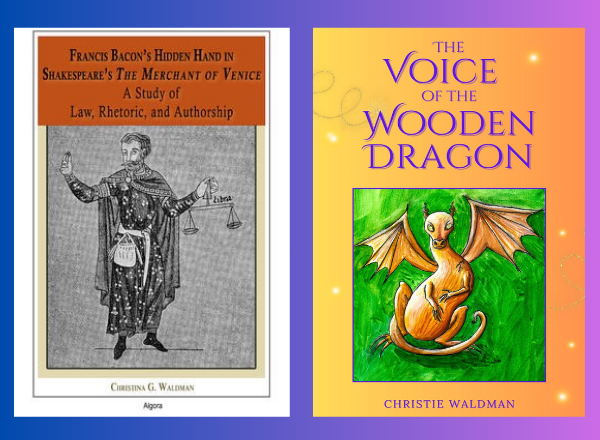
Should it not be obvious that any honest scholar who would dismiss Bacon as a candidate for Shakespeare authorship ought to first become familiar with the case for Bacon? In his 740-page book, British barrister N.B. Cockburn has attempted to present that case in a comprehensive and objective manner. Both Brian McClinton (The Shakespeare Conspiracies: Untangling a 400-Year Web of Myth and Deceit (Belfast: Shanway Press, 2008) and Barry R. Clarke (Francis Bacon’s Contribution to Shakespeare: A New Attribution Method (New York: Routledge, 2019) have acknowledged their indebtedness to Cockburn, as do I myself. SirBacon.org presents an online library of Baconian books and articles; see the Bibliographies or do a google search at the site. There are over 1,000 pages of relevant content. Baconiana, the journal of the Francis Bacon Society, has been publishing the research of its members since its inception in 1886. See the Francis Bacon Society website, https://francisbaconsociety.co.uk/. The Francis Bacon Research Trust (fbrt.org) (Peter Dawkins, founder and principal), is another trusted resource (look under the “resource” tab). If you are interested in the question of Shakespeare and law, may I also recommend to you my own book, Francis Bacon’s Hidden Hand in Shakespeare’s The Merchant of Venice: A Study of Law, Rhetoric, and Authorship (New York: Algora Publishing, 2018).
The truth is rarely to be found neatly lying on the surface. Usually, you have to dig for it, and the reward is in the digging (to paraphrase one of Bacon’s anecdotes).
This article has also been posted to SirBacon.org.